Dethroning cars: future-proofing public transit in California, US
Policy Analysis
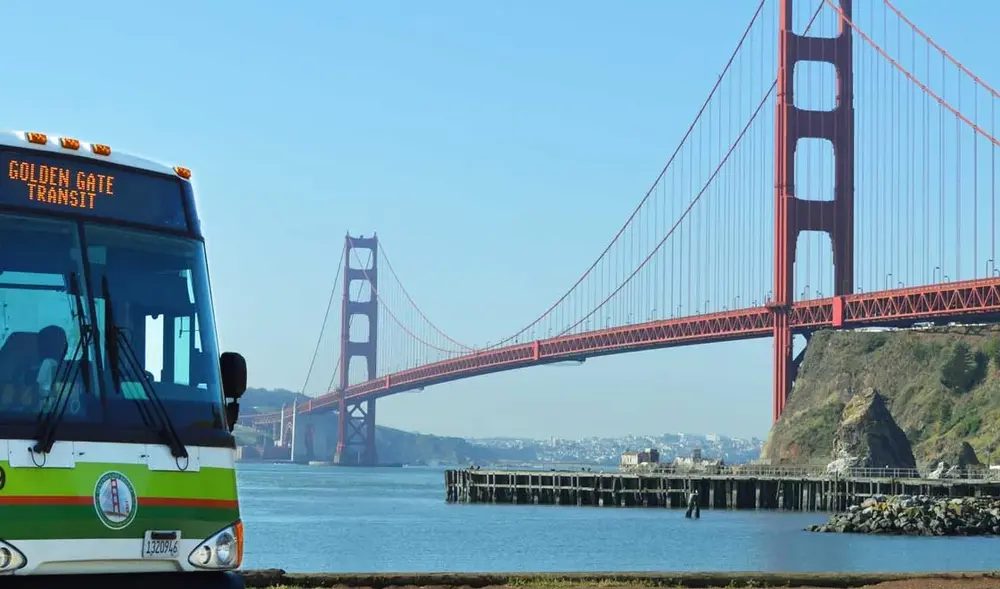
With transportation contributing to 40% of California’s greenhouse gas emissions, there is no question that robust public transit systems must be part of the state’s future if it wants to reach its emissions goals. At the same time, with ridership numbers at an all-time low, Covid-19 has exposed the vulnerabilities of public transit agencies around the state. One lesson from 2020 is clear – to be resilient in the face of an uncertain future, you need to be prepared for it. Only by asking themselves, “What will our cities look like in 20 years?” do transit agencies in California have the chance to start implementing policies that future-proof them to the uncertainty of the years to come.
California Transit’s Troubled Past - and Promising Future?
California, along with the rest of the US, is not known for having quality public transit systems, and there is good reason for this. My own cynicism runs deep – growing up in the suburbs of the San Francisco Bay Area, we lived near a bus stop, but because the bus only came once every hour, the stop was more of a glorified pole than a functional transit point. After college, when I commuted into San Francisco every day by BART (Bay Area Rapid Transit), the regional metro system, I was often befuddled by the slow payment system, ancient infrastructure, and screeching noise – how could this happen in the global capital of technology and innovation?
In 2018, I saw several changes that dampened my cynicism and gave me reason for hope – I used JUMP electric bikes for the first time, allowing me to travel the city’s notoriously big hills in a new way; I walked the green roof of the newly opened Transbay Transit Center; and I first stepped foot in what will in the future become the new fleet of BART cars.
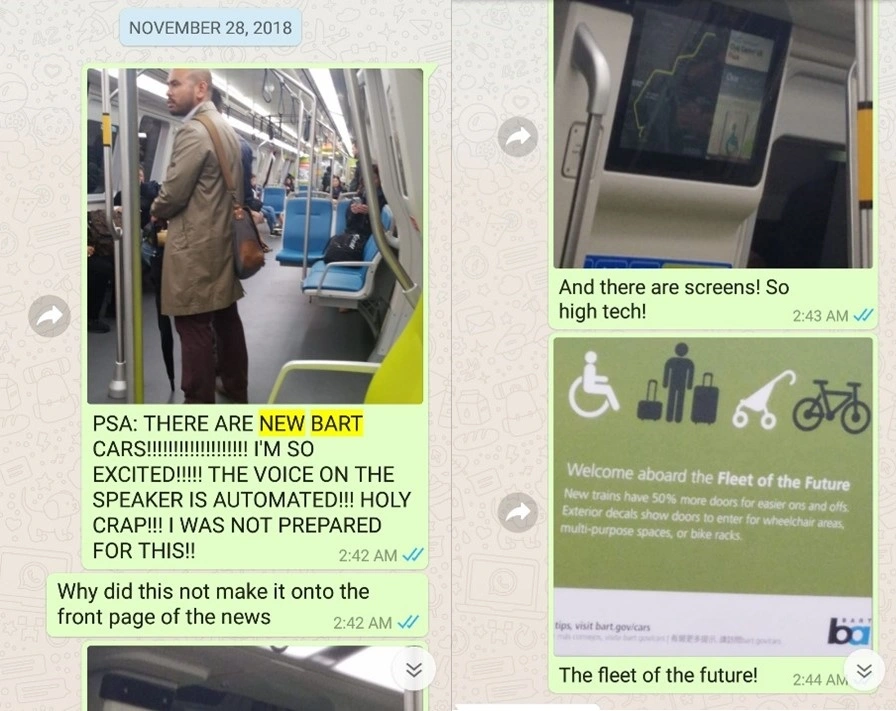
My announcement on the family group chat when I rode the new BART cars for the first time. The fact that I was this excited about automated announcements and screens gives you an idea of the state of BART infrastructure previously...
It turns out that, although urban mobility in California has a long way to go, it is actually a good time to be hopeful. Cities like Los Angeles are receiving more funding than ever before thanks to voters approving sales tax increases, transit systems are benefitting from increasingly progressive housing policies, and California’s ambitious climate agenda makes transportation reforms a necessary part of the conversation. The question is – how do we stay on this track and make sure that new transit systems are resilient to the uncertainty of the future?
A Tool for Uncertainty
As the saying goes, “We can’t predict the future, but we can prepare for it”. This precisely is the goal of scenario planning, a strategic planning method that seeks to deal with the uncertainty of the future by exploring multiple possibilities of what might happen and then creating strategies to deal with those possibilities. This is important for policymaking because, by identifying several plausible futures and exploring the impacts they could have, policymakers can anticipate changes and develop robust policies in response to them.
Urban Mobility in 2040
My group in the course, “Strategic Foresight in Urban Mobility”, headed by Professor Andreas Goldthau and the Mobility Institute Berlin, set out to apply scenario planning to understand what mobility will look like in Los Angeles by 2040 and how this should inform LA’s transit agency’s policy strategies today in their goal to increase ridership. Note: our group focused on LA, but I think much of the discussion can be applied to the rest of California.
In the end, we constructed four different futures, each having different impacts on public transit. For example, the future that we found to be most favorable for public transit included: people-centered urban design, denser housing, a high variety of private mobility companies (e.g., ride-hailing apps, e-scooters, vanpooling, etc.), high government investment at the state level, and a willingness among consumers to reduce their car usage. A public transit-friendly utopia! From there we identified what strategies LA - and the rest of California - can adopt that would not only nudge the state towards the most favorable outcome but, more importantly, safeguard against the downfalls of the other futures.
Policy Strategies for a Resilient Future
The three main policies that public transit agencies in California should thus adopt to increase ridership and strengthen their resilience are the following:
1. Support transit-oriented development at the state and local level: With the housing shortage in California pushing more and more people to the outskirts of suburbs, leading to longer commutes, transit agencies need to consider how they can shape housing policy in their favor. At the local level, this means working with neighborhood groups who oppose denser housing or bike/bus lanes, and at the state level this means supporting bills that jointly address transportation and housing, such as a requirement to build affordable housing alongside new transit infrastructure.
2. Cooperate with the private market to offer a multimodal travel experience: Private mobility options fill an important gap that transit agencies cannot address, so working together with them can offer riders a more seamless travel experience. We see actions such as unified payment and scheduling technologies, as well as their inclusion in future infrastructure projects, as key.
3. Offer incentives to reduce car usage: One factor that strongly differentiated the transit-friendly future was that people were willing to change their behavior vis-à-vis driving. At the moment, the default action is to drive a car even to go a mile to the grocery store, indicating that without some behavior change, no transit system can be successful. Some ways that transit agencies can encourage behavior like walking or bike-sharing are: offering weekend discounts, opening more “slow streets”, providing group and student passes, and perhaps even investing in some good old marketing.
The Urgency of Future-Proofing
The reality is that without shifting its focus to public transit, California has no chance of meeting its ambitious climate agenda. The stakes of future-proofing its public transit systems thus are high – without taking into account the uncertainty of the future and planning for it, the state cannot adequately implement policies that are in it for the long game. It’s time to dethrone cars and instead give public transit the attention it deserves.

About the author
Caroline von Stein is a first-year MPP student specializing in Socio-Economic Policies and Non-Profit Management. Prior to starting the MPP program, she got her B.A. in Cognitive Science and worked at an education non-profit in Lima, Peru. Her interests lie in international development, sustainability, and urban policy, especially urban mobility and housing.
~ The views represented in this blog post do not necessarily represent those of the Brandt School. ~
![[Translate to English:] Facebook Icon](/fileadmin/SocialMediaIcons/iconfinder_06-facebook_104498.svg "Fakebookseite der Staatswissenschaftlichen Fakultät")
![[Translate to English:] Youtube Icon](/fileadmin/SocialMediaIcons/iconfinder_18-youtube_104482.svg)


![[Translate to English:] facebook icon](/fileadmin/SocialMediaIcons/iconfinder_06-facebook_white.svg)
![[Translate to English:] twitter icon](/fileadmin/SocialMediaIcons/iconfinder_03-twitter_white.svg)
![[Translate to English:] instagram icon](/fileadmin/SocialMediaIcons/iconfinder_38-instagram_white.svg)
![[Translate to English:] YouTube icon](/fileadmin/SocialMediaIcons/iconfinder_18-youtube_white.svg)
![[Translate to English:] xing icon](/fileadmin/SocialMediaIcons/iconfinder_xing_white.svg)