When Governments Weaponize Technology: Lessons from the Pegasus Case in El Salvador for Understanding Political Corruption
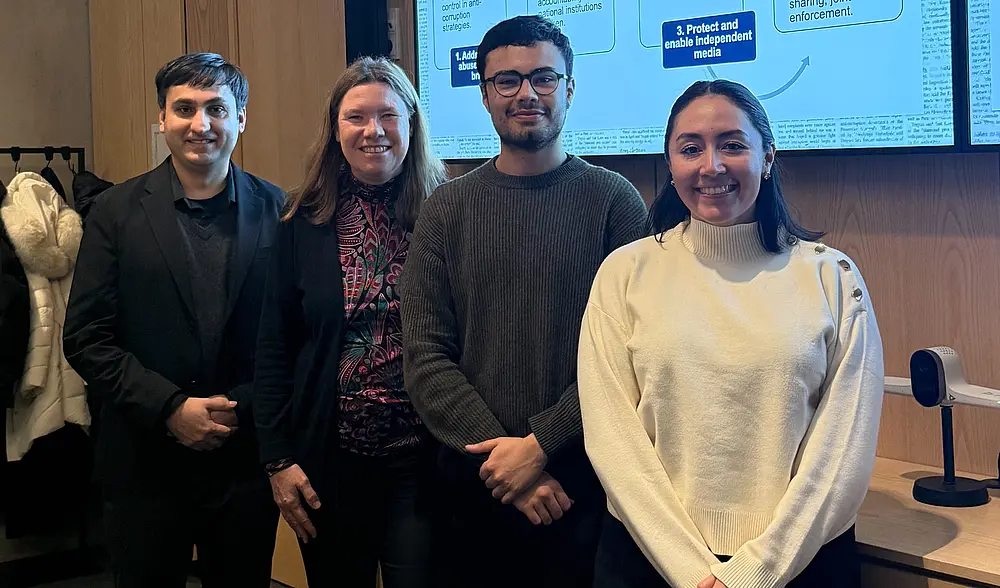
From left to right: Edris Arib, Prof. Dr. Heike Grimm, Juan Hernandez, and Rebeca Olascoaga at the workshop "Understanding Corruption and Promoting Anti-Corruption Efforts".
What comes to mind when you hear the word corruption? Usually, we think of bribery, stolen public funds, or politicians filling their pockets. As policy students from Mexico and Colombia, we have often encountered this kind of corruption in both our studies and professional experiences. The Pegasus scandal in El Salvador tells a different story. Between 2020 and 2021, at least 37 journalists and human rights defenders were targeted with military-grade spyware that could access virtually every aspect of their digital lives (Aljizawi et al., 2022; Amnesty International, 2022). This case reminds us that corruption is not always about money; sometimes it is about using state resources to shield those in power from accountability.
Introduction: The Pegasus scandal
When news broke that journalists and civil society organizations in El Salvador had been targeted with Pegasus spyware, much of the discussion focused on the technology itself. The capabilities of Pegasus are undeniably alarming. Developed by the Israeli company NSO Group and sold exclusively to governments, the software can access messages, emails, calls, photographs, microphones, and cameras without the user ever clicking a malicious link (United Nations, 2022).
Investigations by Citizen Lab (Aljizawi et al) and Amnesty International (2022) confirmed that at least 37 devices belonging to journalists and human rights defenders had been infected between 2020 and 2021. Many of those targeted were reporting on issues that were politically sensitive for the Bukele administration, including alleged negotiations with criminal groups and the management of public funds during the COVID-19 pandemic (Martínez, 2022).
The technical sophistication of Pegasus attracted global attention. Yet focusing only on the spyware risks overlooks a more important question: what does it tell us about the state of democratic governance in El Salvador?
Beyond a privacy violation: When accountability becomes a threat
The surveillance of journalists is not simply a privacy issue. It raises concerns about accountability, institutional checks on executive power, and the ability of independent actors to scrutinize government actions. In any democracy, journalists, watchdog organizations, and civil society groups play a crucial role in exposing wrongdoing and informing public debate. When these actors become targets of state surveillance, the consequences extend beyond the individuals affected. This is what makes the Salvadoran case particularly significant.
The Pegasus infections occurred in a broader political context marked by an increasing concentration of power in the executive branch. Since Nayib Bukele took office, concerns have emerged regarding the dismissal of Constitutional Chamber magistrates, growing executive influence over judicial institutions, restrictions on access to public information, and the weakening of mechanisms traditionally designed to constrain political power (Sermeño, 2022).
At the same time, Bukele has maintained exceptionally high approval ratings, largely driven by the dramatic reduction in homicide rates and public perceptions of improved security. The homicide rate dropped from 106 per 100,000 inhabitants in 2015 to 1.3 per 100,000 in 2025 (Ministry of Public Security and Justice, 2025). Nevertheless, the state of exception declared in 2022 led to mass arbitrary detentions, with prison overcrowding approaching 350%. Restrictions on access to information and freedom of expression have also been documented.
For many Salvadorans, security has understandably become the central political issue. However, democratic institutions are tested not when governments pursue popular policies, but when they face incentives to avoid scrutiny. The Pegasus scandal suggests that surveillance may have been used against individuals whose work involved investigating government decisions and demanding accountability.
The international blind spot
From our perspective as policy students and practitioners from Mexico and Colombia, the Pegasus case feels both relevant and familiar. Spyware markets operate across borders, while oversight mechanisms remain largely national. Companies develop surveillance tools in one country, governments purchase them in another, and the consequences are experienced somewhere else entirely. Hence, responsibility becomes diffuse, enforcement inconsistent, and accountability difficult to achieve.
This regulatory mismatch creates incentives that should concern policymakers. Governments may obtain immediate political benefits from surveillance, while legal consequences remain uncertain. At the same time, private companies profit from the sale of increasingly sophisticated technologies, often with limited transparency regarding how those tools are ultimately used. In practice, the people affected by these arrangements are frequently journalists, activists, opposition figures, and civil society organizations. The broader lesson is that democratic resilience cannot depend exclusively on technological regulation.
Cybersecurity standards, privacy protections, and export controls are necessary. However, they address only part of the problem, as the effectiveness of any safeguard depends on the strength of the institutions responsible for enforcing it. Independent courts, oversight bodies, investigative journalism, and free information mechanisms remain essential precisely because governments possess powerful tools that can be abused.
For this reason, anti-corruption frameworks should pay greater attention to digital abuses of power. The misuse of surveillance technologies against journalists and watchdog actors should not be treated solely as a security or privacy concern, but also as a governance issue that affects transparency, accountability, and democratic integrity. Addressing these risks requires coordinated action at the international, domestic, and local levels, including stronger export controls, mandatory human rights due diligence for surveillance vendors, greater transparency regarding the sale and use of spyware, and stronger legal protections for journalists and human rights defenders, particularly in contexts where institutional checks are already under pressure.
A question of oversight
The Pegasus scandal in El Salvador offers an important reminder that democratic erosion rarely occurs through a single dramatic event. More often, it unfolds gradually, through decisions that weaken oversight, limit scrutiny, and concentrate power. Surveillance technologies can accelerate that process, but they do not create it on their own.
Ultimately, the question raised by Pegasus is not only who has access to powerful surveillance tools. It is whether democratic institutions remain capable of ensuring that those tools are subjected to meaningful oversight. When journalists and watchdog organizations can no longer operate freely, transparency suffers. And when transparency suffers, accountability becomes increasingly difficult to sustain.
~ The views represented in this blog post do not necessarily represent those of the Brandt School. ~
Further reading (key sources)
Aljizawi, N., Deibert, R., Marczak, B., Nigro Herrero, P., Scott-Railton, J., Solimano, S., & Razzak, B. (2022, January 12). Project Torogoz: Extensive hacking of media and civil society in El Salvador with Pegasus spyware. Citizen Lab. https://citizenlab.ca/research/project-torogoz-extensive-hacking-media-civil-society-el-salvador-pegasus-spyware/
Amnesty International. (2022, January 18). El Salvador: Amnesty International verifies use of Pegasus spyware for surveillance of journalists. https://www.amnesty.org/en/latest/news/2022/01/el-salvador-pegasus-spyware-surveillance-journalists/
Martínez, C. (2022). El Faro and the Pegasus scandal in El Salvador. El Faro. https://elfaro.net
Ministerio de Seguridad Pública y Justicia. (2025). “El 2025 representa el año más seguro en la historia patria”: Ministro Gustavo Villatoro. Gobierno de El Salvador. https://www.seguridad.gob.sv/el-2025-representa-el-ano-mas-seguro-en-la-historia-patria-ministro-gustavo-villatoro/
Hellman, J. S., Jones, G., & Kaufmann, D. (2000). Seize the state, seize the day: State capture, corruption, and influence in transition (Policy Research Working Paper No. 2444). World Bank. https://doi.org/10.1596/1813-9450-2444
Transparency International. (n.d.). What is corruption? Transparency International. https://www.transparency.org/en/what-is-corruption
Sermeño, Á. (2022). Nayib Bukele: un populista millenial [Nayib Bukele: a millennial populist]. Retrieved from: https://raco.cat/index.php/Astrolabio/article/view/402877
United Nations Human Rights Council. (2022). Surveillance technologies and human rights: Report of the Special Rapporteur on the promotion and protection of the right to freedom of opinion and expression (A/HRC/51/17). United Nations. https://undocs.org/A/HRC/51/17
About the Authors
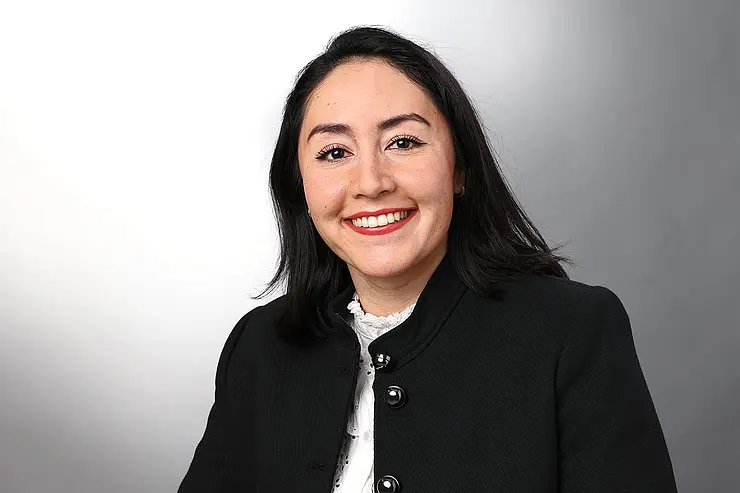
Rebeca Olascoaga Carbajal García is a Mexican Master of Public Policy candidate at the Willy Brandt School of Public Policy and a DAAD Helmut-Schmidt Program scholar. She brings experience in governance, gender equality, security sector reform, and democratic accountability, with a particular interest in how institutions respond to complex social and political challenges in Latin America and beyond.

Juan Felipe Hernández González is a Colombian Master of Public Policy candidate at the Willy Brandt School of Public Policy. He holds a double degree in International Relations and Journalism. He has experience in the public sector and has worked with political parties, bringing expertise in strategic communications and the role of social media in modern society.
![[Translate to English:] Facebook Icon](/fileadmin/SocialMediaIcons/iconfinder_06-facebook_104498.svg "Fakebookseite der Staatswissenschaftlichen Fakultät")
![[Translate to English:] Youtube Icon](/fileadmin/SocialMediaIcons/iconfinder_18-youtube_104482.svg)


![[Translate to English:] facebook icon](/fileadmin/SocialMediaIcons/iconfinder_06-facebook_white.svg)
![[Translate to English:] twitter icon](/fileadmin/SocialMediaIcons/iconfinder_03-twitter_white.svg)
![[Translate to English:] instagram icon](/fileadmin/SocialMediaIcons/iconfinder_38-instagram_white.svg)
![[Translate to English:] YouTube icon](/fileadmin/SocialMediaIcons/iconfinder_18-youtube_white.svg)
![[Translate to English:] xing icon](/fileadmin/SocialMediaIcons/iconfinder_xing_white.svg)