Who Governs a People-Led Energy Transition? Lessons From Pakistan's Solar Boom
Policy Analysis
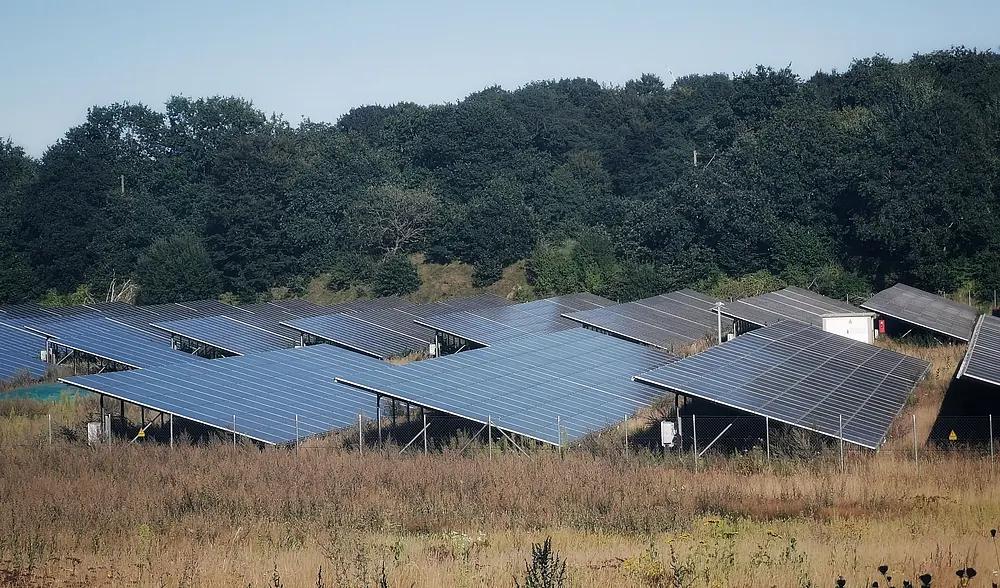
Energy transitions are usually treated as government-led projects. States set targets, run auctions for solar and wind farms, and design subsidies to steer investment. As solar panels have become cheaper, however, a different kind of transition has emerged, in which citizens install their own systems faster than governments can plan. South African households turned to rooftop solar during years of power cuts (Mathibedi et al., 2026); in Pakistan, the same process has unfolded on a far larger scale.
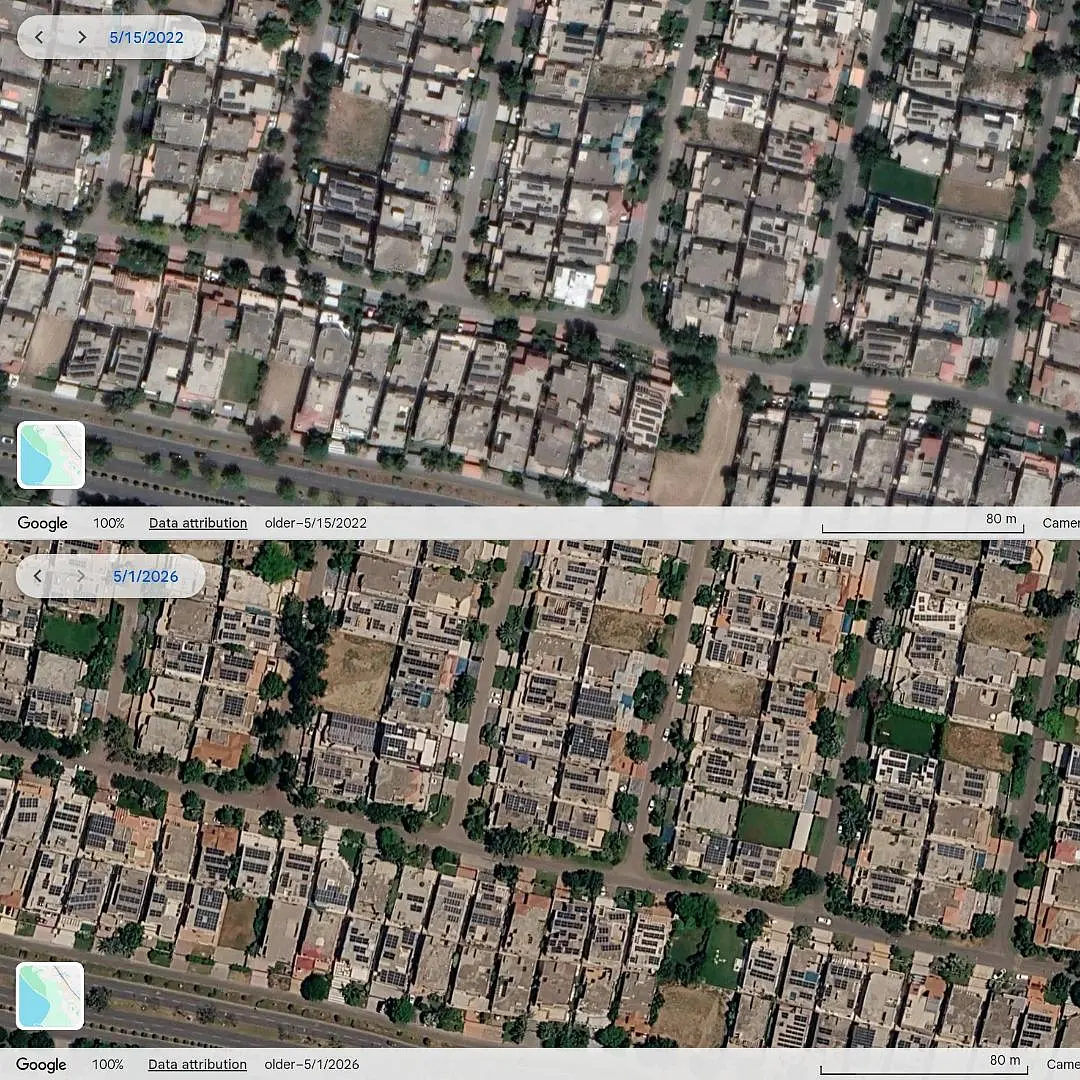
Figure 1: Rooftops in DHA Lahore showing solar transition over the years, May 2022 (top) and January 2026 (bottom).
By mid-2025, Pakistan had imported around 50 GW of solar panels, financed largely by households, farmers, and firms rather than by the state or donors (Amirali, 2026). By February 2026, this shift had helped the country avoid an estimated $12 billion in fuel imports (CREA, 2026).
Pakistan also illustrates the main weakness of such transitions. Citizens organised effectively to install panels, but not to maintain the grid they still depend on. Drawing on Elinor Ostrom's work on shared resources, this article argues that the key challenge of people-led transitions is not adoption, but governance.
A Shared Grid That Nobody Looks After
Pakistan's solar users fall into three groups: net-metering users, who export surplus power to the grid; behind-the-meter users, who stay connected but consume far less grid electricity; and off-grid users, who have disconnected entirely.
Each group reduces the revenue utilities collect, while the grid's fixed costs, including long-term payments to power plants owed whether their electricity is used or not, remain unchanged. The result is a system where millions of individually rational decisions collectively erode the infrastructure everyone depends on.
This is what Ostrom (1990) called a commons problem. Her framework was built around resources such as fisheries and forests, where exclusion is inherently difficult. Electricity grids differ: states control connections and can exclude consumers. But as Hess and Ostrom (2007) argued, the relevant condition is not whether exclusion is theoretically possible, but whether it is feasible at the scale required to prevent cost-shifting. In Pakistan, it has not been. Amirali (2026) describes the outcome as a structural shift of electricity access from the public to the private domain, driven by uncoordinated individual choices rather than policy.
To successfully govern such shared systems, Ostrom identified several core design principles, three of which are critical here: active monitoring, participatory decision-making, and decentralized governance. Pakistan has struggled on all three counts.
First, monitoring is weak. During fiscal year 2024-25, net-metering consumers injected 1,431 GWh into the grid (NEPRA, 2025), yet an estimated 19 GW of grid-connected systems and 8.3 GW of off-grid systems operated outside official statistics (Bazilian & Chattopadhyay, 2026). A parallel electricity system has emerged beneath the official one, largely invisible to planners.
Second, Participation has been limited. After years of leaving the market to itself, the state intervened from above: in February 2026, the regulator replaced net metering with net billing (NEPRA, 2026), which Yousuf (2026) estimates reduces the value of rooftop solar generation by 44–49% for a household exporting most of its output. The reform was introduced with little consultation and amended two months later to exempt existing users. Ostrom (2010) argued that neither markets nor the state alone can govern complex shared systems well; Pakistan's swing from one to the other illustrates why.
Finally, governance remains centralised, with one national framework applying to large factories and small farms alike.
Governance in Practice
Ostrom's condition of multi-level, participatory governance already has practical precedents. Germany offers a different model. More than 1,000 energy cooperatives have been founded there since 2006, with around 220,000 members, 95% of them individual citizens (DGRV, 2024). Most set minimum shares at €500 or less, allowing people without suitable roofs or significant savings to co-own renewable projects. Pakistan need not adopt this model, but it shows that people-led energy can be organised collectively rather than only household by household.
Lessons Learned
As solar costs continue to fall, more countries with expensive or unreliable grids will face transitions like Pakistan's. Three things will determine whether they go well.
The first is recognising that individual action and collective governance are not the same thing. Citizens can build an energy transition faster than any state programme, but they cannot sustain the shared infrastructure everyone still depends on. Governments should plan for this from the start, not after the problems appear.
The second is keeping the transition visible. Distributed solar that sits outside official statistics cannot be planned around, taxed fairly, or made safe. Registering systems, certifying installers and mapping what has actually been built are not bureaucratic details; they are preconditions for governing the grid.
The third is designing reform with, not against, the people it affects. Pakistan's net-billing reform was technically defensible but procedurally contested, and it was revised within months. Evidence from Ostrom's research and from energy governance more broadly suggests that rules made with stakeholder participation are more durable than those imposed from above, and less likely to push people off the grid entirely.
From Individual Action to Collective Governance
Pakistan's solar boom shows that citizens can change an energy system faster than governments can plan one, and falling costs mean other countries are likely to follow. It also shows the limits of individual action: each household solved its own problem, while no one took responsibility for the shared grid. For governments, the question is therefore not only how to promote renewable energy, but how to govern transitions citizens have already begun. Ostrom's work suggests this is possible, provided those who depend on shared resources are treated as partners rather than as a problem to be managed.
~ The views represented in this blog post do not necessarily represent those of the Brandt School. ~
References
Amirali, A. (2026). State and capital in Pakistan's rooftop solar transition. Geoforum, 175, 104738. https://doi.org/10.1016/j.geoforum.2026.104738
Bazilian, M., & Chattopadhyay, D. (2026, August 3). Pakistan's solar surge [Commentary]. Payne Institute for Public Policy, Colorado School of Mines. https://payneinstitute.mines.edu/pakistans-solar-surge
Centre for Research on Energy and Clean Air. (2026, March 17). The hedge that paid off: How Pakistan's solar boom is shielding it from the Hormuz crisis. https://energyandcleanair.org/the-hedge-that-paid-off-how-pakistans-solar-boom-is-shielding-it-from-the-hormuz-crisis/
DGRV. (2024). Energy cooperatives in Germany: State of the sector 2024 report. German Cooperative and Raiffeisen Confederation. https://www.dgrv.de/wp-content/uploads/2024/07/DGRV_Energiegenossenschaften_Umfrage_2024_Englisch.pdf
Hess, C., & Ostrom, E. (2007). A framework for analysing the knowledge commons. In C. Hess & E. Ostrom (Eds.), Understanding knowledge as a commons: From theory to practice (pp. 41–81). MIT Press.
Mathibedi, G. S., Mokgohloa, K., & Ramdass, K. (2026). An assessment of rooftop solar photovoltaic adoption in South Africa: A system dynamics analysis of drivers, constraints, and equity implications. Renewable Energy. https://doi.org/10.1177/27533735261438308
National Electric Power Regulatory Authority. (2025). State of Industry Report 2025. https://nepra.org.pk/publications/State_of_IndustryReports_2025.pdf
National Electric Power Regulatory Authority. (2026). NEPRA (Prosumer) Regulations, 2026 (S.R.O. 251(I)/2026). https://nepra.org.pk
Ostrom, E. (1990). Governing the commons: The evolution of institutions for collective action. Cambridge University Press.
Ostrom, E. (2010). Beyond markets and states: Polycentric governance of complex economic systems. American Economic Review, 100(3), 641–672.
Yousuf, M. U. (2026). From net metering to net billing: Insights from Pakistan's 2026 prosumer regulatory reform. Next Energy, 13, 100871. https://doi.org/10.1016/j.nxener.2026.100871
About the Author
Jawaria Abbasi is a Pakistani Master of Public Policy candidate at the Willy Brandt School of Public Policy, specialising in International and Global Public Policy. She draws on experience coordinating an EU-funded governance reform programme with the Senate of Pakistan and has a research interest in energy governance and democratic accountability. She believes that rigorous research only creates impact when it is communicated clearly to the people who need it most, and brings that conviction to her writing
![[Translate to English:] Facebook Icon](/fileadmin/SocialMediaIcons/iconfinder_06-facebook_104498.svg "Fakebookseite der Staatswissenschaftlichen Fakultät")
![[Translate to English:] Youtube Icon](/fileadmin/SocialMediaIcons/iconfinder_18-youtube_104482.svg)


![[Translate to English:] facebook icon](/fileadmin/SocialMediaIcons/iconfinder_06-facebook_white.svg)
![[Translate to English:] twitter icon](/fileadmin/SocialMediaIcons/iconfinder_03-twitter_white.svg)
![[Translate to English:] instagram icon](/fileadmin/SocialMediaIcons/iconfinder_38-instagram_white.svg)
![[Translate to English:] YouTube icon](/fileadmin/SocialMediaIcons/iconfinder_18-youtube_white.svg)
![[Translate to English:] xing icon](/fileadmin/SocialMediaIcons/iconfinder_xing_white.svg)